Marietta is one of the places we work most, and its crawl spaces cover just about every era of Georgia building. A house a few blocks off the Marietta Square, a ranch in East Cobb and a newer build out toward the county line each have their own way of going wrong underneath. Our shop in Woodstock is about 10 miles up the road, so getting to you is never a long trip.
What's going on under Marietta homes
The older houses near the Square sit on foundations built long before anyone talked about sealed crawl spaces. Many have vents, bare or half-covered dirt, and wood framing that has spent decades breathing damp air. Some have been added onto more than once, so one crawl space can turn into three different sections with three different problems.
East Cobb has a lot of mid-century ranches. A ranch puts a big footprint over a big crawl space, and that means a lot of floor framing exposed to moisture. In many of these homes the original beams and joists have started to sag, the old insulation has dropped, and the plastic on the ground, if there is any, gave up years ago.
Newer houses around Cobb County aren't off the hook. Builders still put in vented crawl spaces with a thin liner, and Georgia summers push humid air through those vents every day from late spring into fall. Underneath it all is red clay that holds rain long after a storm passes and lets it rise slowly as vapor.
Cracks and sags: the Marietta warning signs
Moisture is only half the story in Marietta. Because so many homes here have concrete block foundations and older framing, we pay close attention to structure on every inspection. Here's what tends to show up:
- Stair-step cracks running through the mortar joints of a block wall, often near a corner.
- Horizontal cracks along a block wall, which can mean soil pressure is pushing on it and should be looked at soon.
- Sloping or bouncy floors, especially in the middle of the house where a beam spans the longest distance.
- Doors that stick or drywall cracks above door frames that keep coming back after you patch them.
- A musty smell that gets stronger when the heat or AC turns on.
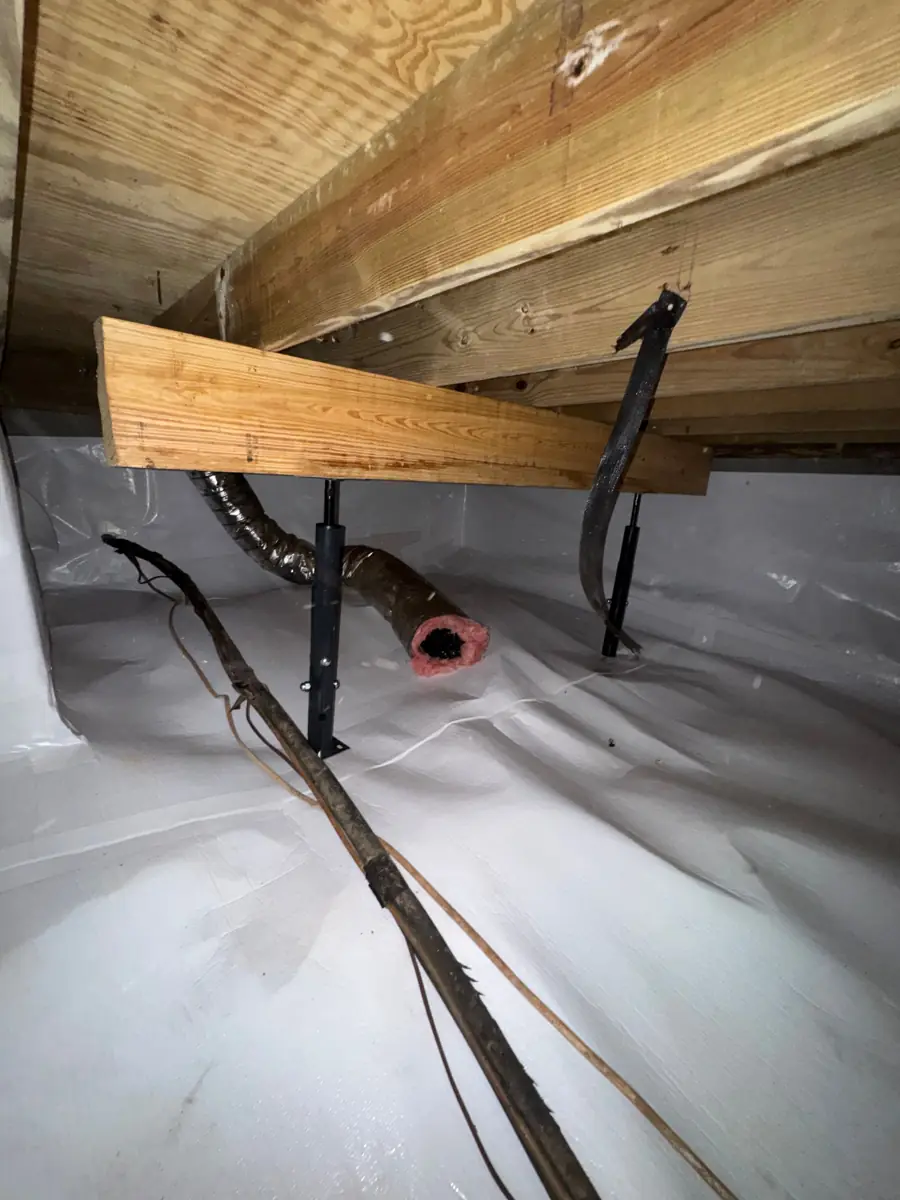
- Wet, hanging insulation, rusty duct straps or sweating pipes.
- Mold or white fuzz on joists and the underside of the subfloor.
If you're seeing a crack and a sag together, don't seal the space and hope. The framing needs support first, or you're wrapping a problem in plastic.
How we encapsulate a Marietta crawl space
We start with a free inspection and a written quote. Jacob Powers has more than 20 years in this trade, and he'll tell you plainly what your space needs and what it doesn't. A full crawl space encapsulation from PPS usually includes:
- Cleanup of old plastic, debris and failed insulation.
- Drainage and a sump pump first, if water collects in the space.
- Structural support where the framing sags, before anything gets sealed.
- Air sealing the foundation vents, gaps and rim joist where needed.
- A reinforced vapor barrier across the floor and up the walls, with seams taped and piers wrapped.
- A sealed access door.
- A crawl space dehumidifier sized to your space.
Our systems carry a lifetime warranty, with the written terms in your quote. If you want to understand what drives the cost before we visit, our guide to how encapsulation is priced in North Georgia walks through it. Financing is also available.
Structural repair and encapsulation, one visit
In Marietta, encapsulation and structural work go together more often than not. When an original crawl space has sagging beams or undersized supports, we install adjustable support jacks, add sister beams beside weak framing, or set piers where the floor needs a solid footing. Our structural stabilization page covers those options in more detail.
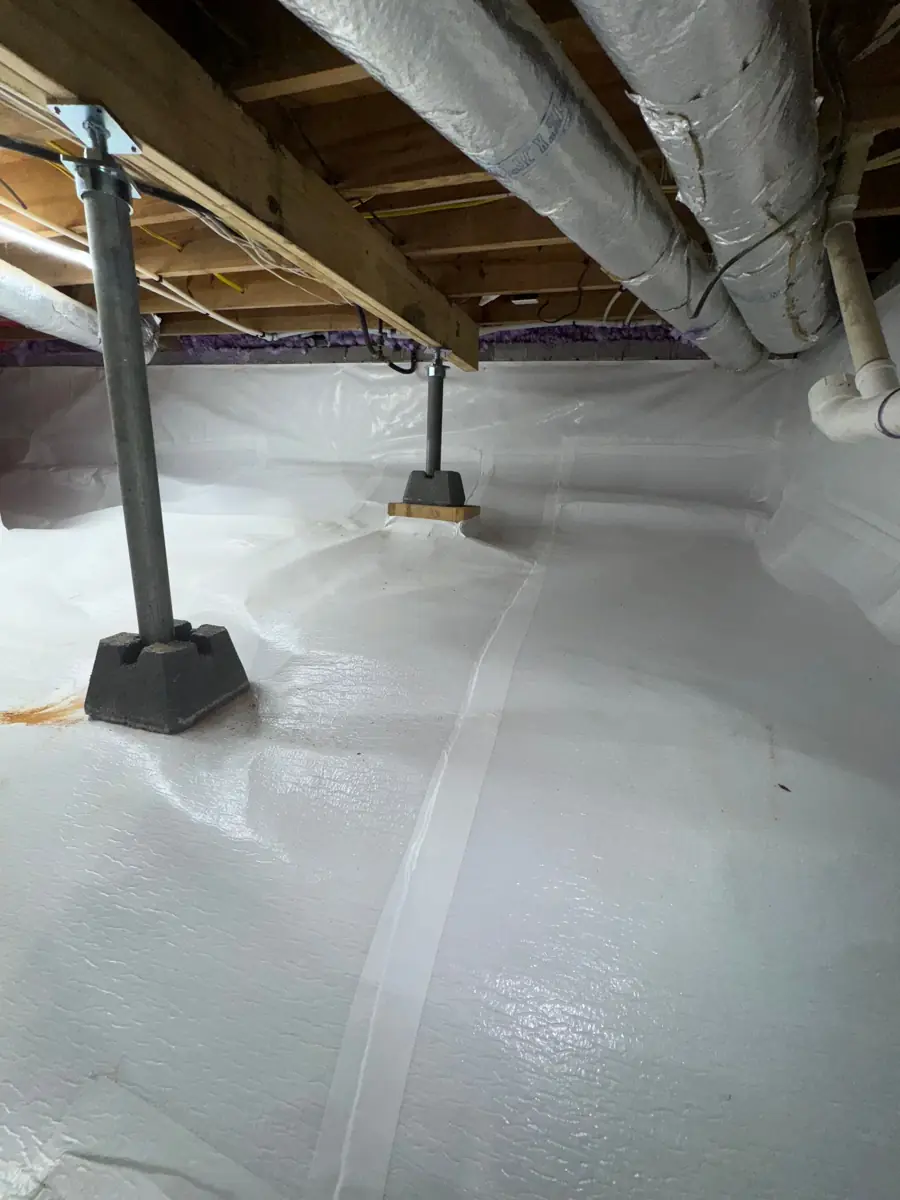
Doing both in one project makes sense. The framing gets support, the liner goes in around the new jacks and piers, and the whole space ends up dry and solid at the same time.
Some homes also need help with water before it reaches the crawl space. Downspouts that dump next to the foundation are common on older lots, and underground downspouts carry that water away. A sealed crawl space also needs humidity control. The EPA recommends keeping indoor humidity below 60%, ideally between 30% and 50%, and a dedicated crawl space dehumidifier is how we hold it there.
Recent work just up the road in Kennesaw
One of our recent crawl space jobs was next door in Kennesaw. That home had water problems, so we installed 130 linear feet of drainage with a sump pump first. Then we encapsulated 1,200 square feet of crawl space, put in an Aprilaire dehumidifier and weather-stripped the access door so it seals tight. It's a good picture of the order we work in: water out, space sealed, air kept dry. You can see more on our projects page.
Where we work in and around Marietta
We cover the whole city of Marietta and the surrounding parts of Cobb County, including ZIP codes 30060, 30062, 30064, 30066, 30067 and 30068. That runs from the historic streets around the Square to East Cobb neighborhoods and the areas near Kennesaw Mountain.
We also work in nearby towns, including Kennesaw, Smyrna, Powder Springs, Roswell and Sandy Springs. For everything else we do in town, visit our Marietta service area page.
Book a free crawl space inspection in Marietta
If your floors have started to dip, a block wall has a crack you keep looking at, or the house just smells damp, let us take a look. We'll check moisture, framing and drainage, and you'll get a written quote with no pressure attached.
Call Jacob at (470) 574-8323 or request your free inspection online.